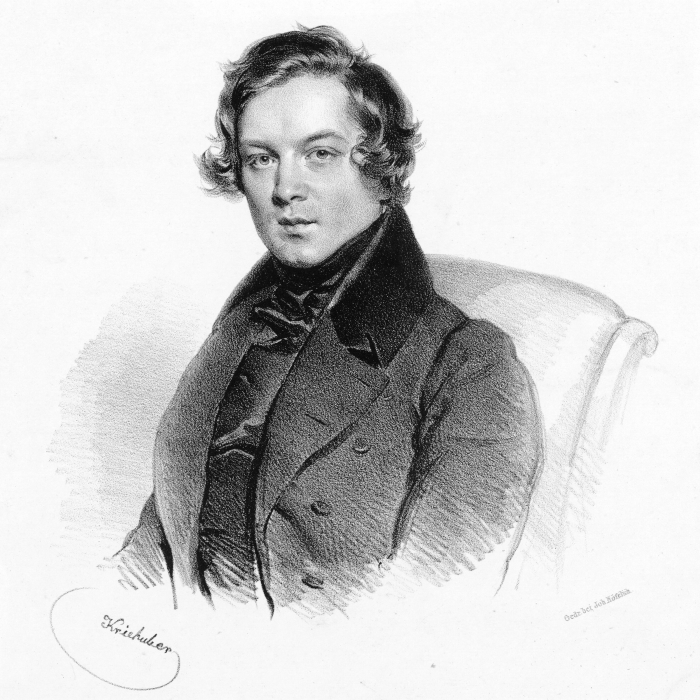
I rediscovered Robert Schumann’s Second Symphony while working out at the gym. I was listening to an Apple playlist of “Joyful Classical” music when the symphony’s scherzo movement played. I had heard this “tour de force for the strings” before but couldn’t have told you who wrote it.
Pieces like Schumann’s 2nd Symphony used to stump me and my parents when we played our own version of Name That Tune at dinnertime. Station WRR’s announcer withheld the title and composer of a work until it finished. While the music played, my parents and I would guess what it was and probably would have confused Schumann with someone else.
We might have guessed Brahams, whom Robert Schumann and his wife Clara championed as a young composer and practically adopted in the 1840s. Music historian Robert Greenberg devotes a blog post to what happened next, and the PBS series Now Hear This includes a digression about the Brahams/Schumann connection.
Getting back to Schumann’s Second Symphony, I love the ominous trumpet call at the beginning, which Leonard Bernstein analyzes in a 1953 recording that encompasses the entire symphony.
Unlike lesser composers who meander, Schumann has something definite to say. His statements stick in my ear and play in my head all night. To turn them off, I try to think of other music. I sang “Amazing Grace” at a service today; maybe that will do the trick.


Thanks so much for sharing your thoughts on Schumann’s 2nd Symphony. The description if your family’s version of Name that Tune is hilarious. Thanks. Name That TuneSent from my iPhoneOn Jul 31, 2026,
LikeLike
Thanks for you comment, Nestor. Yes, we had a good time trying to identify the compositions and composers. One that always fooled us was a symphony by Bizet. I think of him only as the composer of Carmen.
LikeLike
Not trusting the blog software, I am responding directly to your message, to say (sheepishly) I don’t know the difference between Schumann and Schubert — whose lives overlapped, I see. Mainly I am aware of Schubert’s “Unfinished” symphony, a great work, I believe. Beethovian? Both Schumann and Schubert died young, at 46 and 31, which humbles me again by comparison. Your recollections of listening to WRR and trying to guess the identity of composers are good stuff and a reminder that my parents did not listen to classical music. We never listened to WRR at dinnertime or anytime. Just saying.
Have to mention that I saw a filmed version of the Broadway hit “Hadestown,” a reworking of the Orpheus and Eurydice myth to a blues-based score, with a small band playing onstage, including a prominent trombonist! Maybe this is not news to you, but it was to me, and to Elizabeth and Susannah, who were there as well (limited engagement). We all loved it. Powerful, tuneful, relevant. Great performances. I recommend it if you haven’t seen it and get the chance. The musical opened on Broadway in 2019 and is coming to Dallas in a road show engagement next winter, but this is the original Broadway cast. I’d like to see it live, but this is close — like what they’ve done with operas from the Met, I think.
I know the Rasputin Zoom is Thursday. We’re going to be in Santa Fe, but it shouldn’t matter. I finished the book and found it disappointing after a very promising and amusing build-up. The post death encounter with Terry Southern was a surprise, but for me not a good one. I look forward to hearing how others responded.
Sean
>
LikeLike
Thanks for your comment, Sean. From what I gather, both Schubert and Schumann died of syphilis contracted from prostitutes. Both a tragic loss to music and listeners. I love Schubert’s Unfinished Symphony. Both Schubert and Schumann wrote hundreds of Lieder. I’m listening to a Schubert (piano?) sonata arranged for classical guitar and cello. His simple, melodic invention is incredible. I know less about Schumann. I didn’t know the Second Symphony until I stumbled across it in the Apple playlist. I think it’s a masterpiece, probably better than his other three. I’ll check them out.
I had never heard of Hadestown. I’d like to know who the trombonist was. The musical sounds interesting. I’ll see if I can watch it on YouTube if not in person.
LikeLike