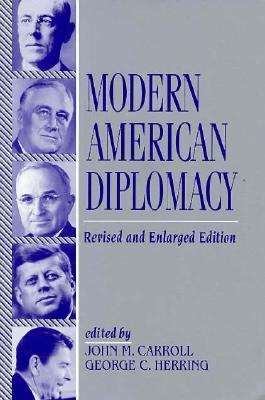
I’m reading Modern American Diplomacy (1996), a collection of articles about the foreign policies of five US presidents. One of the articles, “The Diplomacy of the Depression,” contains this description of FDR.
“After the tremendous election victory in which he swept forty-two out of the forty-eight states, the new president established an administration that was personal, centralized, and haphazard. Steeped in the aristocratic tradition of noblesse oblige, Roosevelt had an exalted sense of his own position and unlimited confidence in his own influence and abilities.
“He fully regarded himself as the equal of royalty and preferred personal conferences with foreign statesmen to indirect negotiations through official channels and subordinates. He supplemented his personal conduct in diplomacy by keeping in close contact with foreign representatives in Washington, by transacting business in a slipshod fashion over the telephone with his own representatives in capitals abroad, and by sending personal emissaries on diplomatic missions.
“He was not a systematic thinker but rather an on-the-spot improviser, pragmatic, even capricious. Frequently he accepted contradictory advice. Go “Weave the two together,” Roosevelt told a surprised adviser who presented him with two conflicting versions of a tariff proposal.
“Despite all that has been written about him, he remains an extremely enigmatic man, a reserved and self-sufficient figure, one not easily influenced, who quite independently made up his own mind and followed his own advice. ‘Never let your left hand know what your right hand is doing,’ he once told his close friend, Henry Morgenthau. ‘Which hand am I, Mr. President?’ he asked. ‘My right hand, but I keep my left hand under the table,’ Roosevelt answered.”
I am struck by how much the description of FDR matches that of President Trump—the identity with royalty, the self-confidence and reliance on instinct v. advice, the diplomacy by phone call and the sending of emissaries v. diplomats, even a weave and a tariff.
 Books, bicycles, and 'bones
Thanks for this. Again I tried to leave a comment, not sure it worked. I said this enlarged my basic image of FDR. I already learned that credit for much of the New Deal belongs to Frances Perkins, a Mount Holyoke grad. At least he had the good sense to hire and trust her — a woman!
>
LikeLike
The name Frances Perkins rings a bell. I’ll look her up to find out more.
LikeLike